
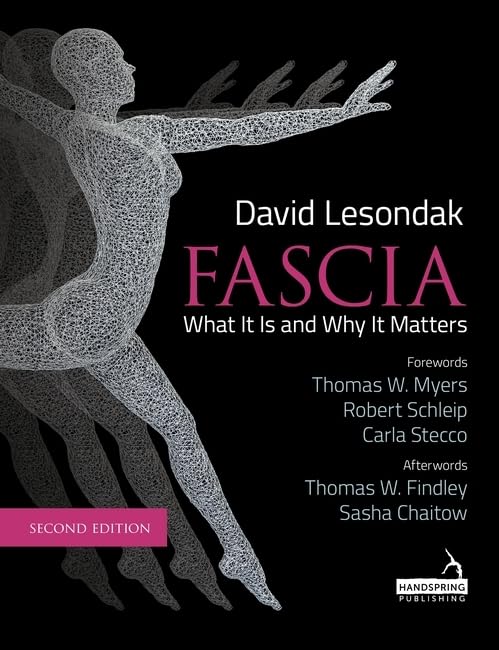
The second edition of Fascia: What It Is and Why It Matters, the first being the “must-have” book for everyone wanting to learn more about fascia as a tissue and a system, maintains the high standard of the first book while expanding on everything that made it so popular.
By focusing first on the fundamentals of fascia as a tissue that surrounds, supports, and permeates all the muscle, bones, nerves, and organs, Lesondak takes the reader on a journey throughout their entire body from the perspective of the fascial system, making many stops along the way to make sure the reader understands what it is that’s important and why it matters to the body.
From the new rules of biomechanics, biotensegrity, cellular processes, musculoskeletal issues, proprioception, neuroscience and cognition, somatic dysfunction, and restoration-Lesondak deftly weaves it all together with a deep appreciation for the history of science, fine storytelling sensibilities, and a sense of humor as well as a sense of wonder.
Review
Fascia: What Is and Why It Matters is a remarkably lucid text for such a multifaceted topic. Once again, David Lesondak demonstrates his extraordinary ability to distill complex science and clinical practice into remarkably compelling and lucid prose. His creative illustrations lure you in to keep on exploring, page after page. As an interested scientist and diagnostic pathologist, reading this book stretches my imagination and gives meaningful contexts for everything I see under my microscopic. What a delight!–Neil Theise, MD, Professor of Pathology, NYU Grossman School of Medicine
David’s book is an enthralling clarification of all things fascia related. He distills the anatomical history, evidence and modern day practices of this lesser-known body part and weaves all threads together with a rock and roll sensibility. It’s must read non-fiction for movement educators, clinicians, manual therapists and anatomy geeks.–Jill Miller, author of The Roll Model, and Body by Breath
I love the way David tells his story by first relating the facts and theories we all need for such a complex subject as fascia. Yet he covers extensive but essential material in a way that leaves you refreshingly in a state of wonderment instead of exhaustion. From there he departs from other authors by weaving in his own perspectives and unique experiences with fascia: as an experienced clinician; as a videographer of anything fascia; and as a genuinely thoughtful, feeling person who cares deeply about what he writes. I thoroughly enjoyed it and so will you.–Chris Frederick
What do reviewers commonly say about Fascia: What It Is, and Why It Matters by David Lesondak?
Key strengths highlighted in reviews
1. Clear and accessible introduction
A dominant theme is that the book provides a straightforward, easy-to-understand explanation of fascia, even for readers new to the topic.
It’s frequently described as an “entry-level overview” that still maintains scientific rigor, making complex anatomy approachable.
2. Strong balance of science and readability
Reviewers consistently praise how the author blends:
anatomy and research
with engaging storytelling and humor
The content is seen as informative without being overly dry or academic, which broadens its appeal beyond specialists.
3. Comprehensive yet concise coverage
Despite being relatively short, the book is often described as:
surprisingly comprehensive
covering key areas like biomechanics, neuroscience, and clinical relevance
It manages to “cover the fascial waterfront” in a compact format.
4. Highly relevant for multiple disciplines
Reviews highlight its usefulness for a wide audience, including:
physiotherapists
massage therapists
movement professionals (e.g., yoga, fitness)
It’s often recommended as a foundational or “must-have” reference for anyone working with the body.
5. Engaging and enjoyable to read
Many readers note that the book is:
engaging, even fun to read
capable of sparking curiosity about anatomy
Some reviews mention it appeals strongly to “anatomy enthusiasts” while still being accessible to beginners.
Common criticisms
1. Introductory level (limited depth)
Some reviewers feel the book:
focuses more on broad understanding than deep technical detail
Advanced readers or researchers may find it not detailed enough for specialized study.
2. Conceptual over procedural
The book emphasizes understanding fascia and its role, rather than:
step-by-step treatment techniques
Clinicians looking for hands-on protocols may need additional resources.
3. Scope can feel broad
Because it integrates many topics (e.g., biomechanics, neuroscience, history), a few readers feel:
certain areas are covered briefly rather than in depth
Overall takeaway
Across reviews, Fascia: What It Is, and Why It Matters is widely seen as:
A highly accessible, well-written introduction to fascia
Strong in clarity, interdisciplinary relevance, and engagement
Ideal for students, clinicians, and movement professionals building foundational knowledge
However, it’s best used as a primer or overview, rather than a deep technical or clinical manual.
Related books:
 Orthopaedic Physical Therapy Secrets
 Dry Needling for Manual Therapists
 An Introduction to the Foot & Its Common Problems in the Adult
 Osteopathic and Chiropractic Techniques for the Foot and Ankle
 The Evolution of the Primate Foot
 Normal and Abnormal Function of the Foot
 Foot and Ankle Biomechanics
 Sarrafian’s Anatomy of the Foot and Ankle
 Origins and Principles of Clinical Biomechanics in Human Locomotion
 Clinical Gait Analysis: Theory and Practice
 Foot and Ankle Instability
 Understanding the Human Foot
 Foot and Ankle Pain Management
 Drennan’s The Child’s Foot and Ankle
 Foot Health Myths, Facts & Fables: Podiatry Reflections